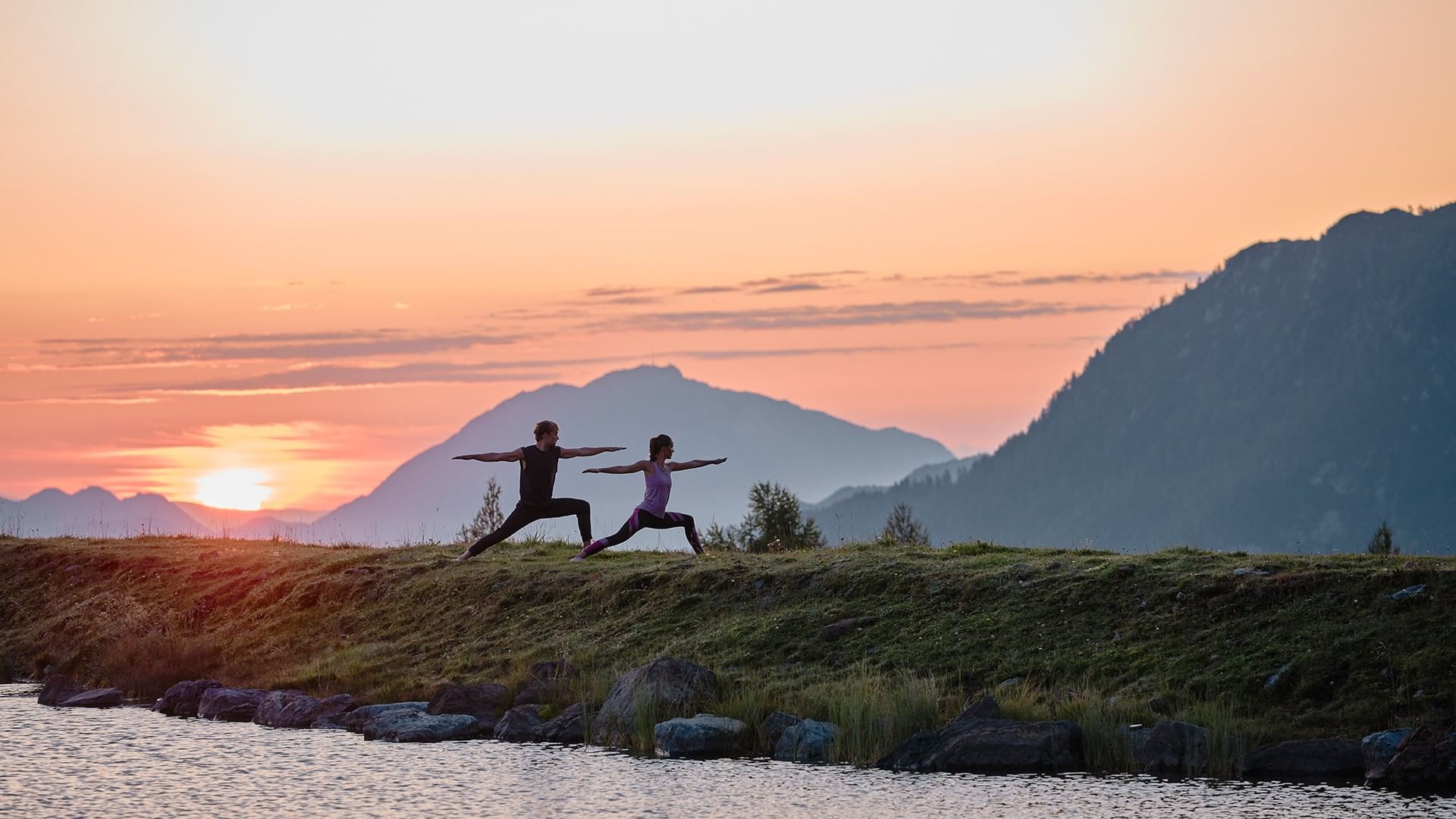
During your stay, a wide range of guided sport and relaxation sessions is available. Our Experience and Sport team is happy to help with any questions.
Let yourself be guided towards physical strengthening or mobilisation, or enjoy meditative relaxation, alone or with others. Please find the weekly schedule here
Day guests may also join the sessions for an additional fee. For more information, please contact reception.
High Intensity Interval Training (HIIT) is an intense form of interval training in which short bursts of exertion alternate with short recovery breaks. This effective full-body workout improves endurance, boosts fitness and ensures a high calorie burn.
Afterburn Workout
A varied full-body workout combining strength and cardio exercises that boosts the metabolism and triggers the so-called afterburn effect. This way, the body continues burning calories even after the workout.
Core Workout
A targeted workout to strengthen the abdominal, back and core muscles. A strong core improves posture, stability and balance, and forms the foundation for many everyday movements and sporting activities.
Abs, Legs & Bum
ALB
An effective strengthening and toning workout for the abs, legs and glutes. Varied exercises strengthen the muscles, stabilise the core and shape the figure in a targeted way.
The Yoga & Relaxation programme includes:
Yoga Nidra
An accessible, guided, and progressive practice that uses different phases, anchors, and tools to cultivate lucid awareness within rest.
Yoga Nidra – literally ""sleep"" – points to a state where the mind settles into stillness while consciousness remains awake: the body rests deeply while attention stays present.
The practice promotes deeper relaxation, improves sleep quality, and helps regulate the nervous system – a path back to pure, content-free presence and to the stable awareness that persists beneath the changing states of body, emotion, and mind.
Yoga for Stillness
A methodology by Tamara Suárez (BSMT Yoga), developed in response to the fast-paced, ever-changing nature of modern life.
Through postures held in stillness, with props when needed, we gather attention inward and awaken the body's natural relaxation response, learning to inhabit it with kind, non-judgmental awareness.
An invitation to slow down and nourish ourselves through silence, calm and introspection.
The practice leads to inner stillness and contentment: a space of stability we can return to whenever needed.
Hatha Yoga
Hatha Yoga is one of the main paths of Yoga, from which most physical or postural styles evolved. Its purpose: self-inquiry toward steadier attention, refined perception and greater presence.
We explore the body through held postures and flowing sequences, alternating stillness and movement. The breath is the central bridge between body and mind, gradually guiding the experience.
Mudras support the flow of vital energy.
The practice becomes a path to stability, clarity and a presence that stays balanced even amid change.
Vinyasa Yoga
A dynamic practice where breath and movement are continuously woven together. Vinyasa refers to the conscious linking of postures—each transition is as meaningful as the posture itself.
Through creative sequences we explore movement without losing the connection to breath.
It is not about reaching a posture but discovering a way of being—we move to perceive more, not to do more.
Gradually, the practice invites us into a state of flow: an embodied movement in which presence arises naturally and the mind becomes more focused.
Meditation
Meditation is a state of awareness in which attention becomes steady, clear, and inwardly directed – not an activity, but a way of remaining present.
We find a stable, comfortable posture; the body settles while attention is gently gathered inward. We learn to notice the mind drawn outward and bring it back to the present moment.
Supports such as the breath, a mantra, or points of focus help stabilize attention.
Gradually, meditation reveals itself as a space where thoughts arise and pass without needing to be controlled – a quiet clarity.